
Guru
'The modernity of yesterday is the tradition of today, and the modernity of today will be tradition tomorrow.' Jose Andres

It should be porridge in front of me.
It's around 0730, its breakfast time, and it really should be porridge in front of me. After years of putting, it off due to a fear of the predictable, I recently went to the doctors and was told the inevitable. The hereditary condition of high LDL cholesterol has been passed on, and like my father and Uncle before me. I need to get more serious about nuts.
And porridge. But it's not porridge today as I just can't face it again.
The golden arches near work is quiet. A couple of people milling around the ordering screens and a couple of gents are sat behind me.
As I dip my hash brown in to the little paper sauce pots everyone is familiar with, the conversation that I can hear behind me draws my idle mind into it. Whilst not knowing the full dynamics of the relationship between the two men, I pick up one being the wise elder and the other as a young buck.
‘Have you heard of Braveheart?’ said the elder. ‘Before he went into battle, he said to his soldiers any hardship you face today - this too shall pass.’
Whatever pre-work sedentary state I was in before hearing the delivery of that quote has now been lifted. Before I have even had a swig of my flat white - I am awake, focused and all in on this conversation.
‘And it's the same for this situation you find yourself in.’ the wise sage continued.
After being presented with a poignant example by the elder, detailing how his brother was betrayed by his wife and best friend, I gleaned that the younger man had recently experienced heartbreak.
The youngling then detailed what sounded like a horrifically toxic relationship between him and his now ex. And whilst of course understanding that I am hearing (eavesdropping) on one side of the story - I would say he is better off without her. But young love wants what young love wants and that first time you make yourself vulnerable for someone, only for them to abuse that gift, brings with it a pain unlike any other.
A boisterous group of construction workers are now in the establishment and their lack of volume control has meant I am starting to struggle to hear the rest of someone else’s business. As the elder raises his voice for impact I hear.
‘Of course, Jordan Peterson says the biggest indication a female will be a slag is…’
I wince at the mention of the man like JP, only to be further frustrated by the inability to hear the conclusion of the almost certainly butchered soliloquy about a women’s chastity due to the commotion over a sausage and egg muffin order.
A briefly question the sanity of just tapping the old boy on the shoulder and ask him to have another run at it, so I can pick up his salient points of that comment. But I am not a fucking madman - so I finished up my breakfast and went to work with the quote ‘Of course Jordan Peterson says…’ ringing around my head.
Guru
On the face of it, Jordan Peterson’s rise to fame seems like a strange cultural phenomenon, unique to the time that we live in. The initially beige looking College Professor came to the world's attention by protesting the ratification of an amendment to Canadian Human Rights Bill which made gender expression and gender identity a protected characteristic.

Peterson's objection to the bill arose from his belief that it enforced compelled speech upon the populace, likening it to the practices of totalitarian regimes that shaped much of the 20th century. Back in 2017, the debate was white-hot, and as we reflect on it in 2025—with the subject’s half-life diminishing—the sheer toxicity of the discourse comes into focus. It was fueled by oversimplifications, crude generalisations, and a pervasive lack of empathy from all sides involved.
But in that searing heat of rank unkindness, Peterson's star was forged. Eight years later, he has become so embedded in the zeitgeist that his presence is inescapable. TikTok is flooded with clips titled “JP Slams Liberal Snowflakes”; movie characters are created mimicking his positions; and countless podcast hours are devoted to his sermons on the plight of the forgotten conservative male. The glorification has reached such absurd levels—just last week, I stumbled across a podcast where his fucking tailor was being interviewed about their interactions with the man.
And, as with any capitalist trend, once the business case for such a personality is proven, the reproductions inevitably follow as the conveyor belt of Novus Magister is turned up to eleven.
But is JP really a unique product of his time, or himself a replica of an earlier model of an academic?
On Heroes, Hero-Worship, and the Heroic in History
The industrial Western world of the 1800s closely mirrored the technological Western world of today. Both eras witnessed rapid advances in the means of production, a swiftly evolving societal order, and the looming threat of mass redundancy as machines and automation advanced. Additionally, global powers jockeying for influence and control over crucial minerals that drive these advancements forward.
And just like today there where the members of academia that feel like the ride of advancement is going too fast, and the brakes need applying.
Step forward Scottish essayist, historian, and philosopher from the Scottish Lowlands - Thomas Carlyle.
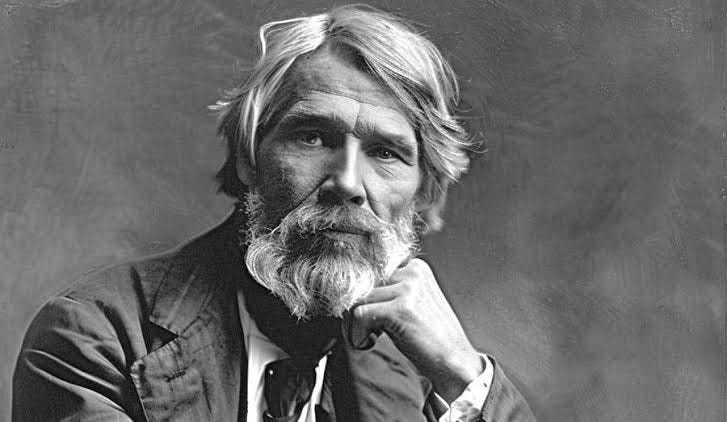
Carlyle viewed the industrial age with a wary eye, admiring its technical prowess but condemning what he saw as its spiritual void. He famously termed this era the "Mechanical Age," a time when humanity, in its pursuit of material progress, risked becoming little more than cogs in the vast, impersonal machinery of industrialisation. Through works such as Signs of the Times and Past and Present, Carlyle urged his contemporaries to look beyond the steam and steel, calling for a return to spiritual values, duty, and the recognition of heroism as a guiding force. His critique struck a chord in Victorian Britain, a nation grappling with the duality of unprecedented progress and profound social dislocation.
For Carlyle, the factories, railways, and chimneys that defined the Victorian skyline were not symbols of triumph but of alienation. In his eyes, the rise of the industrial economy had brought with it a form of "soulless materialism," reducing human life to a mere economic calculation. His biting prose lamented the loss of faith and purpose in a society enthralled by mechanisation and profit. Carlyle’s work was a clarion call to resist the dehumanising effects of modernity, a sentiment that resonates just as deeply today as we grapple with the implications of artificial intelligence and automation.
On of his most famous essays On Heroes, Hero-Worship, and the Heroic in History examines the role of extraordinary individuals in shaping human civilisation, portraying heroes as moral, spiritual, and intellectual leaders who guide society through turbulent times. Carlyle identifies different types of heroes—prophets, poets, priests, and rulers—arguing that their greatness lies in their ability to embody truth and inspire others to transcend mediocrity. This resonates with Jordan Peterson’s work, which draws heavily on archetypal psychology and myth to explore the hero’s journey as a universal path for confronting chaos and achieving personal and societal transformation. Both Carlyle and Peterson place the hero at the centre of their narratives, framing them as necessary figures to navigate periods of moral and cultural disarray, offering not just critique but a roadmap to rediscover meaning and order in a fractured world.
I’m a conservative...get me out of here.
I find comfort in the parallels between Carlyle and Peterson's positions—not because I align with their assessments of society, but because they reveal something deeper. Their ideas don’t shape society as much as they reflect it; their thoughts are not the architects of our condition, but rather products of the cultural forces and anxieties of their times. For those of us committed to building a progressive, peaceful society, we must recognise that the only way to silence the voices of fearful, entrenched conservatives is to continue advancing into modernity. Change is inevitable, and the pursuit of progress requires us to move forward, despite the resistance of those clinging to outdated ideologies.
An excellent way to evidence this point is the fantastic irony that whilst Carlyle and Peterson are both conservatives, both urging societies to take their foot of the accelerator and regress to times that sooth their consciousness. Peterson’s yearning to perpetuate fossil fuel consumption as if we were still in the height of the British Industrial Revolution represents precisely the era that Carlyle feared—a time of rampant mechanisation. This contradiction underscores a deeper truth: conservatism is neither functional nor practical; it is merely the future refusing to be born.